

- Home
- Product Details
Product Details
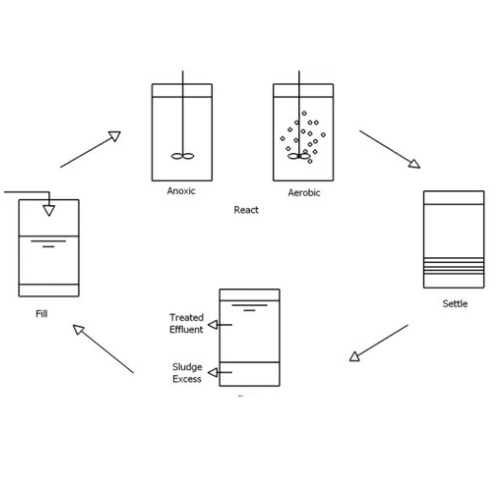
Sequential Batch Reactor
| Product Details | ||||||||||
|---|---|---|---|---|---|---|---|---|---|---|
|
Description
A Sequential Batch Reactor (SBR) is an advanced type of wastewater treatment system used for treating domestic and industrial sewage in a batch-wise process. It is a modification of the activated sludge process where all treatment stages occur sequentially in a single reactor tank instead of multiple separate tanks. SBR technology is widely used in residential complexes, commercial buildings, hotels, hospitals, and small to medium industries due to its compact design, high efficiency, and ease of operation.
The working of a Sequential Batch Reactor is based on a time-controlled cycle that includes five main stages: filling, aeration, settling, decanting, and idle phase. In the filling stage, wastewater enters the reactor tank. During aeration, air is supplied using blowers to promote biological activity, where microorganisms break down organic pollutants such as BOD (Biochemical Oxygen Demand) and COD (Chemical Oxygen Demand). This helps in reducing the pollution load in the wastewater.
After aeration, the system moves to the settling stage, where the aeration is stopped, and solids settle at the bottom of the tank due to gravity. This separates the treated water from the sludge. In the decanting stage, the clear supernatant (treated water) is carefully removed from the top without disturbing the settled sludge. Finally, in the idle phase, the system prepares for the next cycle, and excess sludge is removed if necessary.